WELCOME =)
[ Save the Coral Reefs! ]
[ Use the archives below to read posts ]
[ Credits are given at the end of posts ]
[ IYOR 2008 ]
[ Navigate with the starfishes ]
WELCOME =)
[ Save the Coral Reefs! ]
[ Use the archives below to read posts ]
[ Credits are given at the end of posts ]
[ IYOR 2008 ]
[ Navigate with the starfishes ]

WELCOME =)
[ Save the Coral Reefs! ]
[ Do not litter at beaches ]
[ If everyone does his own part ]
[ We can stop the harming of Coral Reefs! ]
[ Navigate with the starfishes ]


The ICRI International Year of the Reef 2008 is a worldwide campaign to raise awareness about the value and importance of coral reefs and threats to their sustainability, and to motivate people to take action to protect them.
All individuals, corporations, schools, governments, and organizations are welcome and actively encouraged to participate in IYOR 2008.
Ten years ago, 1997 was declared the International Year of the Reef (IYOR). The first IYOR campaign was initiated in response to the increasing threats and loss of coral reefs and associated ecosystems, like mangroves and sea grasses. IYOR 97 was a global effort to increase awareness and understanding of coral reefs, and support conservation, research and management efforts.
IYOR 97 proved to be very successful, with over 225 organizations in 50 countries and territories participating, over 700 articles in papers and magazines generated, hundreds of scientific surveys undertaken, and catalyzed conservation and policy initiatives, as well as numerous local and global organizations dedicated to coral reef conservation.
More information on IYOR 1997 can be found here: http://www.publicaffairs.noaa.gov/coral-reef.html
Recognizing that ten years after IYOR 97 there continues to be an urgent need to increase awareness and understanding of coral reefs, and to further conserve and manage valuable coral reef and associated ecosystems, the International Coral Reef Initiative designated 2008 as the International Year of the Reef (IYOR 2008).
IYOR 2008 will:

The International Coral Reef Initiative (ICRI) IYOR Ad Hoc Committee actively advises, supports and provides guidance to the IYOR 2008 Coordinator in carrying out the ICRI IYOR 2008 Action Plan and accompanying activities. Terms of reference for the committee were approved by ICRI at the Tokyo General Meeting in April 2007. The Committee is chaired by the National Oceanic and Atmospheric Administration (NOAA) on behalf of the ICRI Co-Secretariat. The Ad-Hoc Committee is composed of the following members:


Corals are minute animals which belong to the group cnidaria. Other cnidarians include hydras, jellyfish, and sea anemones.
Corals are sessile animals, meaning they are not mobile but stay fixed in one place. They feed by reaching out with tentacles to catch prey such as small fish and planktonic animals.
Corals live in colonies consisting of many individuals, each of which is called polyp. They secrete a hard calcium carbonate skeleton, which serves as a uniform base or substrate for the colony. The skeleton also provides protection, as the polyps can contract into the structure if predators approach. It is these hard skeletal structures that build up coral reefs over time. The calcium carbonate is secreted at the base of the polyps, so the living coral colony occurs at the surface of the skeletal structure, completely covering it. Calcium carbonate is continuously deposited by the living colony, adding to the size of the structure.
Growth of these structures varies greatly, depending on the species of coral and environmental conditions-- ranging from 0.3 to 10 centimeters per year. Different species of coral build structures of various sizes and shapes, creating diversity and complexity in the coral reef ecosystem. Various coral species tend to be segregated into characteristic zones on a reef, separated out by competition with other species and by environmental conditions.
Virtually all reef-dwelling corals have a symbiotic (mutually beneficial) relationship with algae called zooxanthellae. The plant-like algae live inside the coral polyps and perform photosynthesis, producing food which is shared with the coral. In exchange, the coral provides the algae with protection and access to light, which is necessary for photosynthesis. The zooxanthellae also lend their color to their coral symbionts.
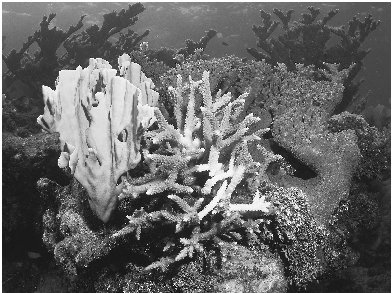
Coral bleaching occurs when corals lose their zooxanthellae, exposing the white calcium carbonate skeletons of the coral colony. There are a number of stresses or environmental changes that may cause bleaching including disease, excess shade, increased levels of ultraviolet radiation, sedimentation, pollution, salinity changes, and increased temperatures.
Because the zooxanthellae depend on light for photosynthesis, reef building corals are found in shallow, clear water where light can penetrate down to the coral polyps. Reef building coral communities also require tropical or sub-tropical temperatures, and exist globally in a band 30 degrees north to 30 degrees south of the equator. Reefs are generally classified in three types. Fringing reefs, the most common type, project seaward directly from the shores of islands or continents. Barrier reefs are platforms separated from the adjacent land by a bay or lagoon. The longest barrier reefs occur off the coasts of Australia and Belize. Atolls rest on the tops of submerged volcanos. They are usually circular or oval with a central lagoon. Parts of the atoll may emerge as islands. Over 300 atolls are found in the South Pacific.
Coral reefs provide habitats for a large variety of organisms. These organisms rely on corals as a source of food and shelter. Besides the corals themselves and their symbiotic algae, other creatures that call coral reefs home include various sponges; molluscs such as sea slugs, nudibranchs, oysters, and clams; crustaceans like crabs and shrimp; many kinds of sea worms; echinoderms like star fish and sea urchins; other cnidarians such as jellyfish and sea anemones; various types of fungi; sea turtles; and many species of fish.
Credits =)
HOW WE NEED THE CORALS
Food
Coral reefs are the home to one quarter of all marine plants and animals (Nearly a million species of fish, crabs, eels, mollusks, sponges, worms, grasses, algae, and other marine animals): They live on reefs or use them as nurseries to protect their young.
Corals also provide natural filtration of seawater for their neighbors.
They support many fisheries that people, especially in coastal nations, depend upon. Destroying of the coral reefs could mean famine.
Shelter
Natural harbors that take millennia to build, coral reefs provide people with living sea walls against tides, storm surges, and hurricanes. They also act as giant sand factories, creating limestone from dissolved minerals in seawater and leaving it behind as sand to keep shorelines from eroding.
Medicine and other resources.
Like the tropical rainforests, coral reefs are a center of extreme biodiversity, a great reservoir of intriguing DNA we've hardly begun to explore and natural compounds we have not yet understood.
Fun and profit
Coral reefs are one big underwater amusement park for snorkelers and divers, a colourful undersea world of Cousteauian delights—which drives a tourist industry worth tens of billions of dollars, in many cases propping up the economies of entire nations.
HOW DO WE REPAY THEM?Overfishing
In areas with an abundant human population, the collapse of the world's fisheries is a familiar story, and tropical regions are the same. Coral reef fisheries are collapsing in many regions, notably South and East Asia, where many over-exploited reefs have been stripped of nearly all edible life.
Blast fishing
In depleted fisheries, people resort to desperate tactics to catch the fish that remain. Dynamites are one of them. The explosions send dead fish to the surface and destroy living reefs; they can be heard from the Philippines to Kenya to the Caribbean.
Cyanide fishing
Restaurants and markets, especially those in East Asia, like to buy live fish; fishermen oblige them by stunning big fish with cyanide sprayed into the water. The fish are caught live, the market momentarily sated, the coral reefs killed.
Sewage
Organic wastes from human cities flood to the sea, bringing an overload of nutrients; algae take over the reefs, blotting out the sunlight corals need to live. It's called eutrophication and it's a major problem, especially in the Caribbean and Central America, where just 10 percent of sewage is properly treated before it's dumped in the sea.
Farm runoff
More eutrophication. Carried to the sea by rivers and streams, chemical fertilizers act much like sewage, overloading reef areas with nutrients for algae, choking the corals. Herbicides and pesticides are a toxic bonus. Florida is a prime example.
Oil and industrial pollution
Petrochemicals and heavy metals are a persistent threat to all marine life in coral reef zones, especially near urban areas and in the seas of the Middle East.
Sedimentation
When people clearcut forests or bulldoze new housing tracts and parking lots, tons of loose dirt is washed downstream and into near-shore reef areas, where it buries corals under a layer of silt and smothers them.
Tourism
Clumsy or just uninformed, tourists crush, scrape, gouge, and break off fragile corals with their hands, their scuba fins, and their ship anchors. Resort development destroys coastal mangroves, creates new sewage sources, and stirs up more silt that smothers reefs.
Disease
Abuse adds up, and reefs that aren't killed directly by people may be getting sick anyway from the accumulated stresses. Recent years have seen epidemics of many coral diseases and the discovery of several new ones previously unknown to science. Coral bleaching, a deadly ailment on the rise, is associated with higher water temperatures—but even that can be attributed to humankind if global warming models are correct. And the diseases seem to be getting meaner: In April, scientists reported in the journal Nature that a new species of coral-bleaching and -killing bacteria was wiping out reefs in two or three days, rather than the weeks or months it took previously.
Climate disruption
Coral bleaching aside, global warming will cause some obvious problems for corals, like decreased ocean salinity and rising mean ocean depth. Then there are the less obvious problems: Australian scientists warned in March 1998 that increasing CO2 in the earth's atmosphere was raising the acidity of surface water in the world's oceans, making it harder for corals to form the (basic) limestone skeletons that make up the reefs.
Coral mining
People excavate coral reefs for their limestone and sand, for use in building materials, resort hotel beaches, tourist souvenirs, even snake-oil medicines: A Swedish company, Ericssons Preventive Medical Group, claims its Alka-Mine Coral Calcium will "naturally detox the body by neutralizing the acidity with which we are all...too apt to pollute our systems." Sweden, of course, has no coral reefs; the product's mineral-rich coral sand is mined off Okinawa.
Mangrove destruction
The familiar tree of swamps from Mississippi to Mozambique, the mangrove provides a crucial service to coral reefs: It filters silt and even pollution out of terrestrial runoff before it can taint the clear water of the reef zones. People chop down mangroves for firewood and clear them for coastal construction.
Marine scientists, like their counterparts elsewhere in the conservation biology community, are making small strides toward the design of large-scale bioreserves. Coral experts at the University of York in England have discovered that concentrations of protected coral areas "upstream" in ocean currents can help regenerate damaged areas "downstream."
Scientists may even have a new form of first aid for injured reefs: Researchers at the University of Guam have managed to cultivate 10 species of coral, which they hope will lead to full-blown aquaculturing. This would allow aquarium suppliers to "farm" coral, hopefully reducing pressure on threatened reefs. Another possible application would be to grow live "patches" to be applied to damaged reefs, helping them regenerate. Stateside aquaculturists in Pittsburgh and the Treasure Valley area of Idaho also are breeding captive corals, both as a hobby and to establish a bank of corals that could be transplanted to damaged reefs.

 A very long limbed starfish
A crab playing in the sand
 A sea anemone
These pictures are really cool aren't they? I probably would never have gotten a chance to see such close-up pictures of nature if not for my teacher, Miss Lim.
These pictures show the all-natural and very interesting side of nature, which are slowly disappearing, bit by bit.
Save the coral, save the Earth. That's our motto.
~ ♥ Wei Ling ♥ ~


 Sea turtle eating a plastic bag, which it had mistaken for a jellyfish.
Also, if human beings had been more concerned about the rainforests, so much more of the lush green, filled with a diversity of wildlife, would still be around. With more rainforests, the air would be cleaner, the ozone layer wouldn't be depleted as badly and wildlife probably woudn't face the danger of extinction.


All these problems that the world is facing in present day are mainly caused by the harm done to nature in the past.
People used to cut down trees without blinking an eye; hack away at the coral for income, not caring whether their actions then would affect the world in any way.
With the depletion of the ozone layer and the increase of greenhouse gases, the threat of global warming arises. Global warming melts the ice caps at the Earth's poles, which in turn flow into the seas and oceans, increasing sea levels. When sea levels increase, low land areas would experience flooding and small islands might even be completely submerged.


Every single problem that I have mentioned are in actual fact, inter-related.
The coral reefs, which are home to so many sea creatures, are decreasing steadily in number, along with all the marine life. If we don't do something about the situation now, the coral reefs will eventually disappear one day.
~ ♥ Wei Ling ♥ ~
They depend on mangroves and seagrass.
Mangroves: Salt-tolerant trees with submerged roots that are a nursery and breeding ground for birds and most of the marine life that migrates to the reef. Mangroves trap and produce nutrients for food and habitat, stabilize the shoreline, and filter pollutants from the landbase.
Seagrass: Flowering marine plants that are an important part of the food web. They provide foods and habitat for turtles, manatees, many fish, filter-feeding organisms and foraging sealife such as sea urchins and sea cucumbers. Seagrasses are a nursery for pink shrimp, lobster, snapper and other sealife. They filter the water of sediments, release oxygen and stabilize the bottom.
How people helped in saving the Coral Reefs
~Living coral reefs are the foundation of marine life, and thus a crucial support for human life.
~Already 10 percent of the corals are lost, and scientists say 70 percent of all corals on the planet will be destroyed in 20 to 40 years unless people stop pollution, sewage, erosion, cyanide fishing, clumsy tourism
~Seriously save the coral reefs now! There's hope as coral reefs are resilient and can bounce back quickly when protected.
~Ordinary people are protecting it.
~Government efforts in much of the world are late, weak, underfunded, unenforced.
>Persian Gulf oil states set toothless pollution laws and then ignore them.
>Indian Ocean poachers outwit and outnumber British Royal Navy patrols.
>Ecuador stalls for decades while tourism explodes in the delicate Galapagos, and enforce a plan that makes it worse.
~Fishermen, students, divers, biologists and concerned citizens of all walks of life transform into activists and volunteers, using initiative to protect the coral reefs that are dear to them and vital to us all.
~Key West dive operators launched Reef Relief to keep ship anchors off Florida's dying reefs.
~One Pacific Islands environmental consultant crusaded to restore the giant clam to Tonga's depleted reefs.
~A group of marine scientists, alarmed by their findings and frustrated with government inaction, launched last year's International Year of the Reef, a global research and education program to spur coral conservation efforts and reverse the trend of destruction. Their call to action has made a difference: Conservationists and governments worldwide made launched the International Coral Reef Initiative in 1997, and the United Nations followed their lead and declared 1998 the International Year of the Ocean.
MoJo Wire presents the first installment of the Mother Jones Action AtlasTM: Coral Reefs. It's the first comprehensive look at the state of the world's reefs that shows what you can do to help.
::Credits::
ACTION ATLASTM Team:
Writers: Paul Kretkowski, Monica Mehta
Research: Suzie Larsen, Mat Honan
Producer: Jennifer Villagran
Designer: Caroline Joy
Technical/Production: Caia Grisar
Editor: Keith Hammond
NGO Directory courtesy of Coral Reef Alliance
Photo Acknowledgements:
Coral Reefs Home Page: Mike Hurley (top left), Denise Jackett (bottom left)
Middle East: Jeff Rotman (top left), Jay Ireland and Georgienne Bradley (bottom left)
Indian Ocean: Norbert Wu (top left), Stephen Frink (bottom left)
East Asia: Jones/Shimlock-Photographers/Aspen (top left and bottom left)
Pacific: Jones/Shimlock-Photographers/Aspen (top left), Norbert Wu (bottom left)
Tropical Americas: Norbert Wu (top left and bottom left)
Reefs in Trouble: Wolcott Henry (top right), Mike Hurley (top left), Denise Jackett (bottom left)
Diver's Guide: Brian Parker/Tom Stack & Assoc. (top right), Mike Hurley (top left), Denise Jackett (bottom left)
http://www.motherjones.com/news/special_reports/coral_reef/

 Underwater wonders...

